- Published: June 25, 2026
5 Signs Your Hospital Desperately Needs a Queue Management System
Queue Management System adoption is no longer just a technology upgrade for busy hospitals — it is becoming a critical requirement for managing patient flow, reducing waiting-room chaos, and improving the overall OPD experience.
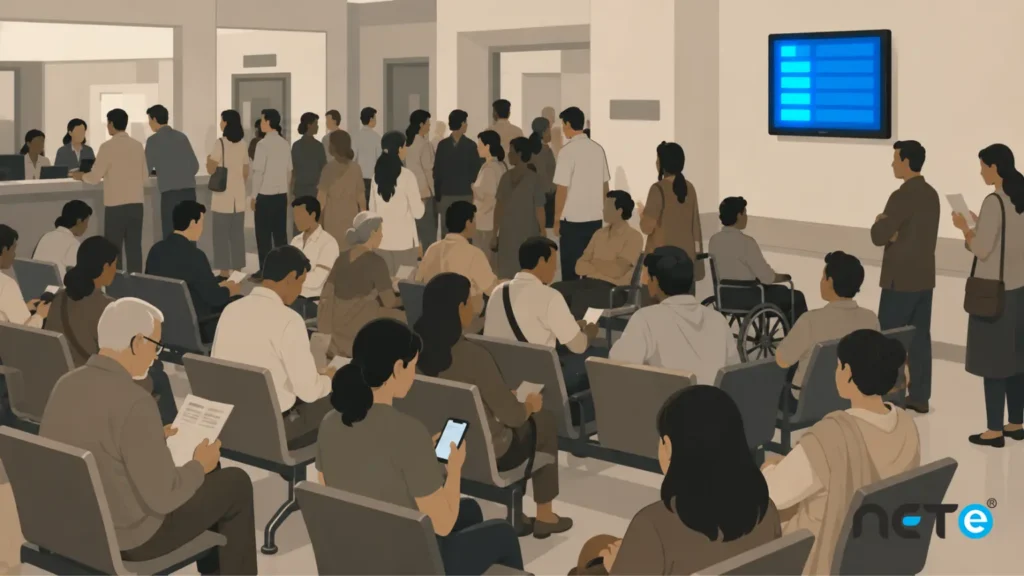
Walk into the OPD of almost any busy Indian hospital on a weekday morning, and you’ll see the same scene: a packed waiting area, a handwritten or printed token in someone’s hand, and a front desk fielding the same question over and over — “How much longer?”
This isn’t a minor operational quirk. It’s a measurable, recurring drain on patient satisfaction, staff time, and ultimately, revenue. The average patient in an Indian hospital OPD waits 45 minutes for a consultation that lasts just 5 minutes — and that wait routinely stretches to 45 minutes to 2 hours in busy OPDs. Research into Indian hospital queues has found that 71% of patient waiting time is attributable to factors within the department itself — meaning the wait isn’t inevitable. It’s largely a process problem, and process problems are fixable.
The hard part is recognizing it early. Most hospital administrators don’t wake up one day and decide they need a Queue Management System (QMS). Instead, the warning signs build quietly — a complaint here, a missed appointment there — until they add up to a pattern that’s costing the hospital real money and real patients. Here are the five clearest signs that the pattern has already started.
Sign 1: Your Waiting Areas Are Constantly Overcrowded
If your OPD waiting area regularly looks like a crowd rather than a queue, this is the most visible — and most dangerous — sign.
Overcrowding isn’t just uncomfortable. It has direct clinical consequences. Overcrowded waiting areas increase the risk of infection, delayed consultations lead to patient walkouts, and frustrated patients are less likely to comply with follow-up recommendations. In a healthcare setting, that’s not just a CX problem — it’s a patient safety and outcomes problem dressed up as a logistics issue.
The root cause is almost always the same: 60–70% of OPD patients in India arrive without appointments, creating unpredictable clusters of arrivals that the hospital has no advance visibility into. Without a system to manage that flow, the waiting room absorbs the chaos instead of your scheduling process.
This is precisely where a Queue Management System changes the picture. Instead of patients clustering physically near the registration desk hoping to be noticed, a digital queue assigns each patient a clear position the moment they check in — whether via self-service kiosk, QR scan, or reception — and lets them know exactly where they stand. NET-e’s QMS is built to handle both appointment-based and walk-in queues from a single dashboard, which is critical in the Indian context where both will always coexist. The result documented across similar deployments: QR-based self-check-in alone reduced front-desk queuing by 60%, easing the physical crowding at its source rather than just rearranging it.
Sign 2: Patient Complaints About Waiting Time Keep Repeating
If “how much longer” is the single most common phrase your front-desk staff hear in a day, that’s not an isolated complaint — it’s a system telling you something structural is broken.
The data backs up just how universal this frustration is. Long waiting times in crowded, disorganized spaces directly affect patient satisfaction and overall hospital management, and the absence of a structured system makes the experience worse than the wait itself. Without a queue display system, patients have no visibility into wait times and frequently ask staff for updates, further consuming staff time and creating a frustrating loop in which the lack of information generates more disruption than the original wait.
This is a well-documented psychological effect, not just an Indian hospital quirk: uncertainty makes waiting feel longer and more stressful than it actually is. A Queue Management System breaks that loop by making wait status visible without staff intervention — token numbers, estimated wait times, and queue position displayed clearly on screens or sent via SMS and WhatsApp. Hospitals that have implemented this report have seen dramatic results: in one Indian deployment, WhatsApp notifications cut physical wait times by 50%. In contrast, another reported that SMS queue updates improved patient satisfaction by 40%. Even where actual clinical capacity hasn’t changed, perceived control over the wait has — and perceived control is often what turns into a five-star review or a walkout.
Pair this with NET-e’s Customer Feedback System, and the complaint pattern itself becomes visible to management in real time rather than surfacing months later in an annual patient satisfaction survey. Instead of guessing which department is generating the most frustration, administrators see it as it happens — and can act before it becomes a trend that shows up in online reviews.
Sign 3: Doctors and Staff Are Constantly Interrupted to Manage the Queue Manually
When your clinical staff — doctors, nurses, front-desk teams — are spending meaningful chunks of their day managing crowd control instead of patient care, that’s a sign the system itself is broken, not the staff.
This shows up in a specific, recognizable way: a nurse or attendant manually calling out names or token numbers, walking between the waiting area and the consultation room to check on queue status, or fielding a constant stream of “am I next?” questions. Removing manual queue handling helps staff redirect their time toward core tasks and increases overall productivity — time that, in a hospital setting, translates directly into more patient-facing care rather than crowd logistics.
The scale of this inefficiency becomes clear when you look at OPD throughput data. One Indian hospital deployment found that intelligent queue flow management led to a 15% increase in daily OPD throughput simply because doctors could see patients faster once the flow was actively managed rather than left to self-organize. Another facility reported a 35% improvement in daily patient handling after digitizing its queue management. At the same time, administrators noted they could finally rely on real-time analytics to plan staff shifts and appointments more effectively, rather than reacting to whatever chaos the day brought.
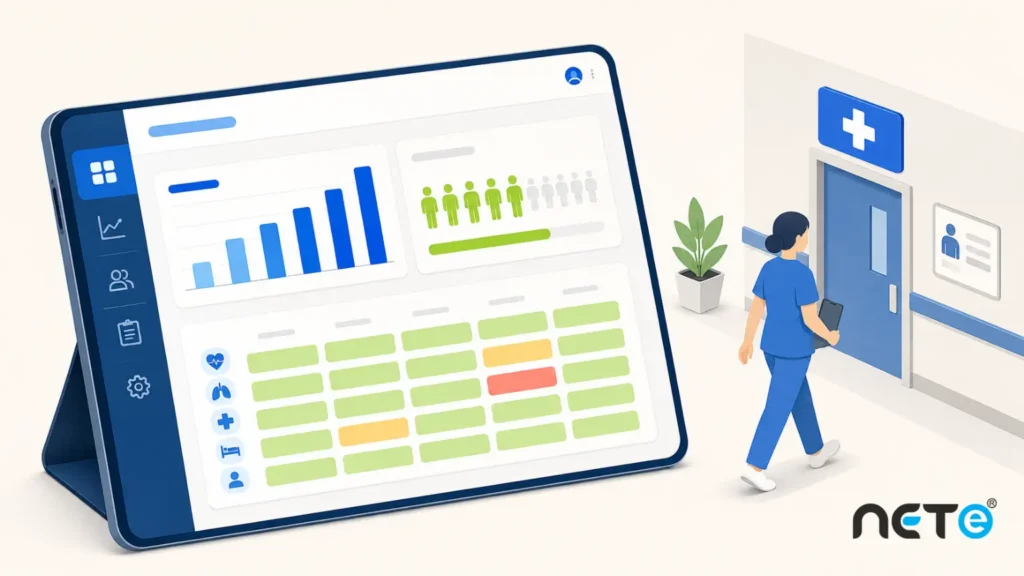
NET-e’s QMS doesn’t just organize the patient side of this equation — it gives administrators the same visibility. Dashboards showing live queue length, average wait time by department, and peak load periods let hospital management make staffing decisions based on data, not instinct. And when paired with a Nurse Calling System, the same logic extends into the wards: instead of staff manually checking each room or relying on patients calling out, nursing staff are alerted immediately when a patient needs assistance — removing another layer of manual, interruption-driven workflow.
Sign 4: You Have No Visibility Into Where Patients Are Actually Getting Stuck
This sign is less visible than overcrowding, but arguably more damaging in the long term: if you can’t say with confidence which specific point in the patient journey is creating delays — registration, a specific doctor’s consultation, billing, pharmacy, diagnostics — you’re managing your hospital’s biggest patient-experience driver blind.
This isn’t a hypothetical problem. Detailed studies of Indian OPDs have found wildly disproportionate time allocations hiding inside what looks like one undifferentiated “wait.” Time-motion studies at hospitals have documented total OPD time stretching to 2 hours against actual consultation time of just 3 minutes — meaning the overwhelming majority of a patient’s time in your hospital isn’t spent with a doctor at all. Without granular data, hospitals end up treating symptoms (adding more chairs, hiring more front-desk staff) rather than the actual bottleneck.
A modern Queue Management System solves this by turning every queue into a data source. Hospitals can track peak times, review service duration, and monitor staff performance through real-time dashboards and deep-dive reports, which means administrators can finally see, for example, that registration is the actual bottleneck rather than the doctor’s consultation pace — or that one specific OPD department is consistently overwhelmed while others run smoothly. Government hospitals seeing 500 to 2,000+ OPD patients a day simply cannot manage this complexity through observation and instinct alone; it requires structured, queryable data.
This same visibility extends naturally into a Customer Feedback System, where patient-reported friction points (a confusing registration process, a long pharmacy wait) can be cross-referenced against the queue data itself — giving hospital management a complete picture of where the experience is breaking down, not just where the queue is longest.
Sign 5: A Sudden Spike in Patient Volume Throws Your Whole Hospital Into Disarray
The final sign is the stress test: what happens when patient volume suddenly spikes — a disease outbreak, a seasonal surge, a local emergency? If the answer is “everything falls apart,” your hospital doesn’t have a queue management problem only in calm periods — it has one that becomes a crisis the moment conditions get difficult.
This scenario has already played out in real Indian hospitals, with instructive results. A district hospital in Rajasthan used a digital queue system to manage patient volumes during a dengue outbreak. Despite a 3x increase in patient load, the system maintained an orderly flow, reduced overcrowding in waiting areas, and enabled administrators to assign additional doctors to overwhelmed departments dynamically. That’s the difference between a hospital that can flex under pressure and one that simply breaks under it.
This kind of resilience doesn’t come from hiring more staff during a crisis — it comes from having a system that gives administrators real-time visibility and the ability to redirect resources the moment a department starts to strain, rather than discovering the problem only once the waiting area is already in chaos. A NET-e QMS deployment paired with an Appointment Booking System adds a further layer of resilience here: by encouraging and managing scheduled visits alongside walk-ins, hospitals reduce the share of fully unpredictable patient arrivals, making volume spikes more manageable even before they happen.
What This Actually Costs Your Hospital
Each of these five signs is, on its own, an inconvenience. Together, they represent something far more serious: a hospital that is quietly losing patients, straining staff, and operating with far less efficiency than it could.
The financial logic is simple, even if hospitals rarely calculate it explicitly. Every patient who walks out of an overcrowded waiting room without being seen is lost revenue and a missed care opportunity — and as documented above, that walkout risk rises directly with wait time and overcrowding. Every staff hour spent on manual queue management or answering “how much longer” is an hour not spent on patient care. And every unaddressed complaint pattern is a quiet, compounding reputational cost that eventually shows up in online reviews and word-of-mouth, ultimately deterring new patients before they ever walk through the door.
How NET-e’s Queue Management System Addresses All Five
NET-e’s QMS isn’t a single fix bolted onto one of these problems — it’s designed to address the full pattern at once:
- Self-service check-in (kiosk, QR, or reception) reduces front-desk crowding and gives every patient an immediate, visible queue position
- Real-time wait status via on-screen displays and SMS/WhatsApp notifications eliminates the uncertainty that makes waiting feel worse than it is
- Live dashboards give administrators visibility into bottlenecks by department, doctor, and time of day — replacing guesswork with data.
- Dynamic queue management supports both walk-ins and scheduled appointments from a single system, reflecting the reality of Indian OPDs
- Surge resilience lets administrators reallocate staff and resources the moment a department shows signs of strain, rather than reacting after the waiting room is already overwhelmed.
Layered alongside NET-e’s Customer Feedback System, Appointment Booking System, and Nurse Calling System, the Queue Management System becomes part of a connected patient experience — not just a ticket dispenser, but the operational backbone that lets a hospital see, measure, and improve the entire patient journey from arrival to discharge.
The Bottom Line
If even two or three of these five signs feel familiar, your hospital isn’t dealing with a minor operational hiccup — it’s dealing with a structural patient-flow problem that’s actively eroding patient satisfaction, staff capacity, and revenue every single day it goes unaddressed.
The hospitals pulling ahead on patient experience in India aren’t necessarily the ones with the most specialists or the newest equipment. They’re the ones that have stopped treating the waiting room as an afterthought and started treating it as what it actually is: the first and most influential part of the patient experience.