- Published: June 29, 2026
How Queue Management Systems Transform Patient Satisfaction Scores in Indian Hospitals
Queue management has quietly become one of the most consequential levers in Indian healthcare’s patient satisfaction story. It shows up in NABH accreditation reviews, in Google ratings that influence which hospital a family chooses next, and in word-of-mouth referrals that drive far more footfall than any marketing campaign. Yet most hospitals still measure patient satisfaction the same way they did a decade ago — through occasional surveys, after the fact, when it’s too late to fix what went wrong.
There’s a specific, measurable lever hiding inside this problem: the queue.
Not the doctor’s bedside manner. Not the hospital’s equipment. The simple, structural experience of waiting to be seen — and whether that wait feels organized or chaotic. The evidence connecting this single factor to patient satisfaction scores is now substantial enough that hospitals can no longer treat it as a minor operational detail.
The Clinical Evidence: A Randomized Controlled Trial
Most claims about “improving patient satisfaction” in healthcare marketing are vague by design. This one isn’t. A randomized controlled trial conducted in a hospital emergency department put queue management to a direct, measurable test.
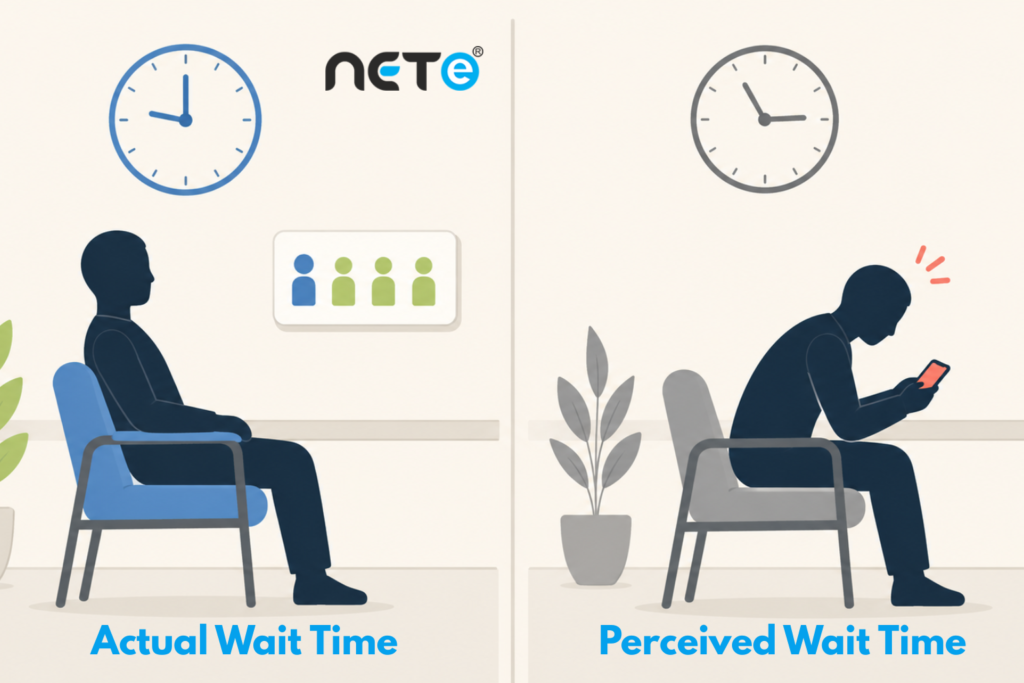
Patients’ perceptions of waiting time and satisfaction were evaluated with and without a queue management system among 236 patients, split into an intervention group and a control group. The results were stark: the mean actual waiting time for the group with queue management was 15.5 minutes, compared to 27 minutes for the control group, and the mean perceived waiting time was 11.9 minutes versus 32.8 minutes, a statistically significant difference.
That second number is the one worth sitting with. The actual time difference was meaningful — roughly 11 minutes shorter. But the perceived time difference was enormous — patients in the queue-managed group felt they’d waited barely a third as long as those in the control group, even though the actual difference was smaller. The researchers’ conclusion was direct: applying a queue management system in emergency department waiting rooms can reduce both actual and perceived waiting times and increase patient satisfaction.
This matters enormously for how hospitals should think about queue management. It’s not just a tool for moving people through faster — it’s a tool for changing how people feel about the time they spend waiting, which is often the bigger lever on satisfaction scores than the clock alone.
Why Perceived Wait Time Beats Actual Wait Time
This distinction between actual and perceived waiting time isn’t a quirk of one study — it’s a documented principle in healthcare operations research. If a hospital can reduce the actual waiting time while also enhancing the perceived waiting time, it improves the patient’s experience on both fronts simultaneously.
In practice, this is exactly what a queue management system does. A patient who can see their token number on a screen, knows roughly how many people are ahead of them, and receives an SMS or WhatsApp update when their turn approaches, experiences the wait completely differently from a patient standing in an unmarked crowd with no information. The clock might say the same number of minutes. The patient’s nervous system does not perceive it the same way.
This is precisely why technology-based queue management systems have been identified as one of the core levers — alongside hospital hygiene, outpatient procedure optimization, and patient-provider communication — for substantially increasing patient satisfaction levels in tertiary care government hospitals. Notice that queue management sits in the same category as hygiene and clinical communication — not as a minor convenience feature, but as a structural determinant of how patients judge the quality of care they received.
From the Ground Up: How Indian Hospitals Built This Into Policy
This isn’t a theoretical framework imported from elsewhere — it’s already built into how some of India’s most prominent hospitals operate, and it’s directly tied to national digital health policy.
Sir Ganga Ram Hospital’s Smart OPD Framework — one of the first of its kind in India — was designed to ensure fast and secure access to vital health information, lab results, queue management, and appointment scheduling, alongside a patient dashboard at the consulting room, as key features in the interest of improved patient care. Crucially, this initiative was designed to complement India’s broader “Digital India” push, positioning queue management not as an isolated hospital convenience but as part of a national direction toward more transparent, technology-enabled healthcare delivery.
The reasoning behind embedding queue management this deeply into hospital architecture comes back to the same core insight: hospital patients’ emotions are influenced by their experiences, and the queue is one of the most universal, most frequently repeated experiences every single patient has, regardless of department, diagnosis, or doctor.
What Happens Operationally When Queue Management Improves Satisfaction
It’s worth being specific about why a queue management system moves the satisfaction needle, because the mechanism isn’t mysterious — it’s a stack of smaller improvements that compound.
Reduced waiting time and smoother registration
Reduced waiting times and a smoother registration process directly improve patient satisfaction, while the same system optimizes resource allocation and reduces staff workload, leading to more efficient healthcare services overall. This is the compounding effect hospitals often miss: faster registration doesn’t just satisfy the patient at that moment, it reduces the backlog that causes delays for every patient who arrives after them that day.
Staff are freed to focus on care, not crowd control.
When queue management takes over administrative coordination, healthcare staff can dedicate more time to patient care, improving the overall service quality patients actually experience. A nurse spent the morning announcing token numbers and managing a confused crowd, has less time and less patience left for actual clinical interactions — and patients notice the difference in how rushed or attentive their care feels.
Visibility replaces guesswork for hospital administrators.
A queue management system provides data analytics that help identify trends, bottlenecks, and areas for improvement in patient flow — meaning hospital leadership can finally see, for instance, that Tuesday mornings consistently overload the cardiology OPD, rather than reacting only after patient complaints pile up.
The reputational effect compounds beyond the visit itself
A satisfied patient leads to a good reputation, and word of mouth can be especially valuable in healthcare, where most people consult friends, family, and co-workers before choosing a medical facility for treatment. In a market where most patients choose a hospital based on someone else’s experience rather than an ad, every patient’s satisfaction score quietly serves as marketing collateral — for better or worse.
A Real Example: From Chaos to Clarity
These mechanisms aren’t abstract. NET-e has seen this pattern play out directly with healthcare clients implementing structured queue management, which walks through the before-and-after of a hospital that moved from an unstructured, token-paper-based OPD to a fully digital queue system with real-time wait status and SMS notifications.
The pattern echoes what’s increasingly common across Indian hospital deployments: significant reductions in physical wait time, fewer complaints at the front desk, and — critically — a measurable lift in patient-reported satisfaction scores within the first few months of deployment. Long wait times in hospitals and clinics aren’t simply frustrating — they can significantly affect patient satisfaction, pride, and even health outcomes, which is exactly why addressing this single touchpoint tends to yield outsized results relative to its operational simplicity.
Beyond Satisfaction Scores: The NABH Connection
For Indian hospitals pursuing or maintaining NABH accreditation, this connection matters even more directly. NABH’s quality framework treats patient satisfaction as a tracked indicator, not a soft afterthought — meaning the same queue management improvements that satisfy patients in the moment also strengthen a hospital’s formal accreditation standing over time. A hospital that can show structured wait-time data, documented patient flow improvements, and rising satisfaction scores isn’t just running a smoother OPD — it’s building the kind of evidence-based NABH reviewers are specifically looking for.
What This Means for Hospital Administrators
If your hospital is still measuring patient satisfaction through infrequent surveys and treating the OPD queue as an unavoidable inconvenience, you’re missing one of the most direct, well-documented levers for improving those scores.
The evidence is consistent across multiple independent sources: randomized clinical trials, hospital-specific case studies, and operational research all point to the same conclusion. Queue management isn’t a “nice to have” digital upgrade — it’s a structural fix that touches actual wait time, perceived wait time, staff capacity, administrative visibility, and ultimately, the reputation that drives your next patient through the door.
How NET-e’s Queue Management System Fits In
NET-e’s Queue Management System is built around exactly the mechanisms described above — not as isolated features, but as a connected system:
- Real-time queue visibility via on-screen displays and SMS/WhatsApp notifications, directly addressing the perceived-wait-time gap shown in the clinical trial data above
- Self-service check-in that smooths registration and reduces the front-desk bottleneck that creates downstream delays
- Live administrative dashboards that surface bottlenecks by department and time of day, replacing guesswork with the kind of data NABH reviewers and hospital leadership both want to see
- Integration with Appointment Booking, Customer Feedback, and Nurse Calling Systems, so the queue isn’t solved in isolation, while other patient touchpoints remain unmanaged
The hospitals seeing the strongest satisfaction score improvements aren’t necessarily the ones with the newest equipment or the most specialists — they’re the ones treating the queue itself as a clinical-quality issue, not just an operations inconvenience.
The Bottom Line
Patient satisfaction scores are no longer a soft, hard-to-influence metric. The data — from randomized controlled trials to national digital health frameworks to hospital-specific case studies — points to the same conclusion: a well-designed queue management system measurably improves both how long patients actually wait and how that wait feels, and that combination is one of the most reliable levers available for moving satisfaction scores in the right direction.
For hospitals serious about improving NABH-aligned quality metrics and protecting their reputation in an increasingly word-of-mouth-driven market, fixing the queue isn’t a minor IT project. It’s a clinical governance decision.