- Published: June 22, 2026
Why Customer Experience Is the New Competitive Advantage for Indian Businesses
For decades, Indian businesses competed on three things: price, product, and proximity. Cheaper than the competitor down the road, a slightly better product range, or simply being the most convenient option in the neighborhood. That playbook worked when customers had limited choices and even less information.
That world is gone.
Today, a patient comparing two hospitals, a customer comparing two banks, or a shopper comparing two retail chains isn’t just comparing what’s on offer. They’re comparing how it feels to do business with each one. And increasingly, that feeling — not the price tag — is what decides where the money goes.
This shift has a name: customer experience, or CX. And the data behind it is no longer a soft, feel-good argument. It’s one of the most measurable, money-on-the-table business cases available to Indian companies right now.
The Numbers Behind the Shift
Let’s start with what’s actually happening, because the scale of this shift is easy to underestimate.
Globally, brands with top-tier customer experience grow revenue 80% faster and report 60% higher profits than companies that lag on CX. That’s not a marginal edge — that’s the difference between a business that compounds and one that stagnates.
Look deeper into the financial mechanics, and the picture sharpens further. 73% of CX leaders outperform their competitors financially, generating up to 5.7 times more revenue from superior customer experiences. And it’s not just about loyalty or referrals — it’s about pricing power too. Up to 75% of consumers say they’re willing to pay a 16% premium for products when a positive service experience is guaranteed.
That’s the upside. Here’s the cost of getting it wrong: businesses worldwide risk losing an estimated $3.7-$3.8 trillion in annual sales as customers switch brands after a poor experience. This isn’t a once-in-a-while inconvenience for companies — it’s a structural revenue leak that most businesses don’t even measure properly.
And the bar for what counts as “poor” keeps rising. 52% of customers say they’ll switch to a competitor after just a single negative impression. Indian businesses no longer get the benefit of the doubt. One bad queue, one ignored complaint, one confusing booking process — and the customer is gone, often without a word, straight to a competitor who got it right.
Why This Matters Even More in India Right Now
If this were purely a global trend with no local relevance, it would be easy to file away as “interesting, but not urgent.” It isn’t.
India’s customer experience management market — the technology and systems businesses use to actually manage and improve CX — is growing fast. Estimates put the Indian CEM market at US$1.06 billion in 2024, projected to reach US$3.3 billion by 2031, growing at a compound annual rate of 17.6%. Other forecasts put India’s CX management market specifically at approximately US$0.81 billion by 2026, within an Asia-Pacific region that is the fastest-growing region globally, driven by mobile-first consumers and rapid e-commerce expansion.
Translation: this is not a “someday” trend. Indian businesses are already investing in this, and the ones that aren’t are quietly falling behind competitors who are.
Nowhere is this clearer than in sectors NET-e works in directly — healthcare, banking, retail, and government services. Take banking as an example. Customer experience in Indian banking has moved from being a service function to becoming a core business differentiator that drives growth, retention, and advocacy. The shift is structural: banks are being pushed to move from reactive servicing to predictive, AI-enabled, empathy-driven experiences that anticipate customers’ needs before they ask.
If that’s true in banking — an industry built on trust and habit — it’s true everywhere else too. Hospitals are competing for patients. Malls are competing for footfall. Government service centers are competing, even informally, against the public’s patience for queues and paperwork. The expectation has shifted, and it’s not shifting back.
What “Customer Experience” Actually Means (Beyond the Buzzword)
Here’s where most businesses go wrong: they hear “customer experience” and think it means a friendlier call center script, or a thank-you email after a purchase.
That’s not customer experience. That’s customer service — one small piece of a much bigger picture.
Real customer experience is every single interaction a person has with your business, stitched together into one continuous impression. It’s:
- How long someone waits before being seen, served, or helped
- Whether they know what’s happening next, or are left guessing
- Whether their feedback is collected — and more importantly, acted on
- Whether the fifth interaction feels as smooth as the first
- Whether the business remembers them or treats every visit like a blank slate
Notice that almost none of these are about the core product or service itself. A hospital can have excellent doctors and still lose patients because the waiting room experience is chaotic. A bank can have great interest rates and still lose customers because the branch visit feels like a chore. The product gets you in the door. The experience decides if you come back — and whether you tell others to come too.
This is precisely why personalization has become non-negotiable rather than a nice-to-have. Businesses that excel at personalization see 40% higher revenue from these efforts than competitors who don’t. And expectations have moved beyond personalization into something closer to anticipation — recent research shows 92% of consumers now expect support to feel tailored to them, and 96% want to move between channels without having to repeat themselves.
The Waiting Room Is Where CX Is Won or Lost
If there’s a single moment that defines the customer experience across India’s service industries, it’s the wait.
In every industry — healthcare, banking, retail, government, and service centers — the waiting experience directly impacts customer satisfaction. And the psychology behind this is well documented: waiting causes stress, frustration, and anxiety, and people feel time moves more slowly when they’re idle or confused. The frustrating part for businesses is that even when the actual waiting time stays the same, a calm and transparent process makes customers perceive it as shorter — meaning the experience of waiting matters more than the literal minutes on the clock.
This is exactly the gap NET-e’s Queue Management System (QMS) is built to close. Rather than leaving customers standing in an unstructured line with no idea how long they’ll wait, a digital queue system eliminates chaos, reduces wait times, improves transparency, and gives customers real-time information about their place in line—the business impact compounds from there. Eliminating long wait times and the confusion that comes with them directly protects customer loyalty and brand reputation, while removing manual queue handling frees staff to focus on service delivery rather than crowd control.
For NET-e’s healthcare clients specifically, the research backs this up at a clinical level. Studies on hospital queue systems have found that a structured queue management system that provides patients with real-time wait-time information measurably affects patient satisfaction in busy hospital settings — and that reducing patient wait times through digital queue management directly improves patient satisfaction scores. This is the same logic behind India’s own digital health pushes: queue management integrated with appointment scheduling and patient dashboards has been used as a flagship initiative under India’s broader Digital India push in hospital settings.
In other words, this isn’t a hardware nicety. It’s a documented lever on how patients, customers, and citizens feel about an organization, often before they’ve even reached the counter.
Feedback You Act On, Not Feedback You File Away
Customer experience also lives or dies on a second factor most businesses get badly wrong: feedback.
Most organizations collect feedback the old-fashioned way — a comment box gathering dust, or an annual survey that arrives long after the moment of frustration has passed. By the time anyone reads it, the customer who complained has often already left for a competitor.
NET-e’s Customer Feedback System is designed around a simple principle: feedback is only useful if it’s collected in the moment and acted on quickly. A real-time feedback loop — captured right after a service interaction, not weeks later — catches small frictions. At the same time, they’re still small, rather than letting them silently erode loyalty across hundreds of customers before anyone notices a pattern.
This matters because customers have become so unforgiving. As covered earlier, 49% of customers who left a brand they were previously loyal to cited a poor experience as the reason. The businesses best positioned to catch that frustration before it turns into churn are those with structured, real-time feedback systems rather than annual surveys. A feedback system isn’t just a listening tool. It’s an early-warning system for revenue you’re about to lose.
Appointments and Calling Systems: Removing Friction Before It Starts
Two more touchpoints deserve attention, because they shape customer experience before a single word is exchanged with staff.
The first is the booking process itself. NET-e’s Appointment Booking System removes the friction of walk-in uncertainty — patients, customers, or citizens know exactly when they’ll be seen, reducing the anxiety of open-ended waiting and reducing the operational chaos of unplanned walk-ins competing for the same staff time. When combined with QMS, this means a customer’s queue position is often known before they’ve even walked through the door.
The second is specific to healthcare: NET-e’s Nurse Calling System. In hospital settings, the experience of being a patient is shaped heavily by how quickly and clearly staff respond to a need — whether that’s a call for assistance from a hospital bed or a structured way to alert nursing staff without relying on shouting down a corridor. A well-implemented nurse-calling system doesn’t just improve response times; it changes how safe and cared for a patient feels during their stay, which feeds directly into the same patient satisfaction metrics that hospitals are increasingly judged on, both by patients and by accreditation bodies.
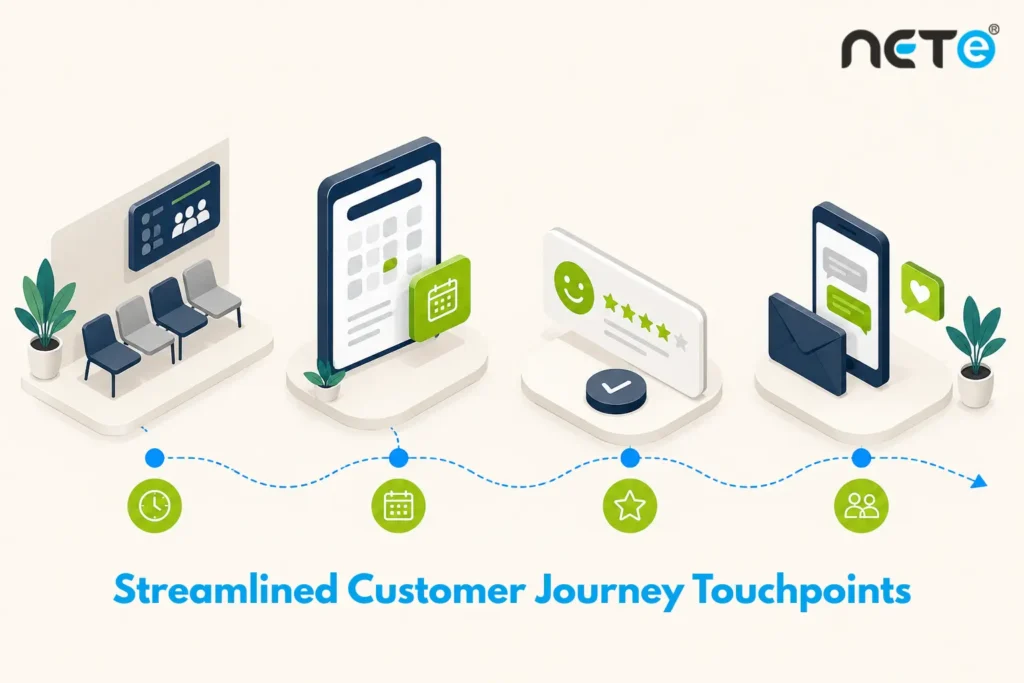
Each of these systems — QMS, Feedback, Appointment Booking, Nurse Calling — solves a specific friction point. Together, they form something closer to what businesses actually mean when they talk about “customer experience transformation”: a connected system where wait times are visible, feedback is immediate, bookings are predictable, and care or service requests are responded to quickly. Across India, banking customer experience solutions and healthcare queue display systems are becoming the new norm for transforming the customer journey — and businesses adopting connected systems rather than one-off fixes are pulling ahead.
The Real Cost of Ignoring This
Let’s make this concrete with numbers that should make any business owner pause.
49% of customers who left a brand they were previously loyal to in the past 12 months say it was specifically because of poor customer experience — not price, not product quality, but the experience itself. That’s nearly half of all customer churn, yet it sits in a category most businesses don’t even formally track or own.
And the customers who stay loyal aren’t doing it passively. 60% of consumers say they’ve chosen one brand over another specifically based on the service experience they expected to receive. People are making purchasing decisions on a prediction of how they’ll be treated — before the transaction has even happened.
Speed matters more than most businesses assume, too. Customers are 2.4 times more likely to remain loyal to a brand when their problems get solved quickly, and 72% expect immediate service as the baseline, not the exception.
Put plainly: the gap between a business that delivers a smooth, fast, well-managed customer experience and one that doesn’t is no longer a soft differentiator. It is now one of the largest, most quantifiable levers on revenue, retention, and word-of-mouth growth available to any business — and it’s measurable in a way “brand reputation” never used to be.
Why Most Indian Businesses Are Still Treating CX as an Afterthought
If the data is this clear, why are so many businesses still behind?
Mostly because customer experience has historically been seen as “soft” — nice to have, hard to measure, and easy to deprioritize when budgets get tight, operations, sales, and product development get dedicated teams, dashboards, and board-level attention. Customer experience gets a suggestion box and a complaint register that nobody really reads.
That mindset made sense when customers had fewer choices and lower expectations. It doesn’t make sense anymore, especially with enterprise adoption of CX platforms climbing from 52% in 2019 to roughly 78% globally by 2024. The businesses that systematized customer experience early are now several years ahead — not just in customer satisfaction scores, but in the operational data and insight that compounds over time.
The good news for Indian businesses: this gap is closeable, and it doesn’t require reinventing your operations from scratch. It requires the right systems sitting at the exact points where customers currently experience friction — the wait, the booking, the feedback moment, the call for help.
Where to Start
You don’t need to overhaul your entire operation overnight. You need visibility into the moments that matter most — and a system to act on what you learn.
That starts with four questions every business, regardless of industry, should be able to answer today:
How long do customers actually wait — and do they know what to expect while waiting? This is precisely what a Queue Management System is built to solve: visibility and predictability, even when the wait itself can’t be eliminated.
Is feedback being collected in the moment, or only after something has already gone wrong? A real-time Customer Feedback System catches problems while they’re still small, not three months later in an annual review.
Can customers book in advance, or are they forced to rely on unpredictable walk-ins? An Appointment Booking System turns open-ended uncertainty into a scheduled, manageable interaction for both the customer and your staff.
If something goes wrong mid-visit, how fast can your team respond? In healthcare specifically, this is where a Nurse Calling System changes the patient experience from passive waiting to active, responsive care.
If you can’t answer these with confidence today, that’s not a failure. It’s simply where the opportunity sits — and where a connected system, rather than a patchwork of manual fixes, tends to make the biggest difference fastest.
The Bottom Line
Customer experience has moved from a “nice to have” into one of the most measurable competitive advantages available to Indian businesses today — across healthcare, banking, retail, government services, and beyond. The companies treating it as a strategic priority, with the right systems in place at the moments that matter most, are pulling ahead in revenue growth, profitability, and customer loyalty. Those treating it as an afterthought are quietly bleeding customers, often without realizing exactly why.
NET-e’s Queue Management, Customer Feedback, Appointment Booking, and Nurse Calling Systems exist precisely because these aren’t separate problems — they’re connected touchpoints in the same customer journey. Fixing them one at a time helps. Fixing them as a system is where the real advantage starts to compound.
The shift isn’t coming. It’s already here, and the data backs it up.